


there's even speculations na Jesus escaped death by crucifixion or escaped crucifixion all in all daw...
i think this is the link here..
i dnt knw if it is credible or not...im just sharing some articles i have read..and im open to debates...
Results 141 to 150 of 193
-
04-03-2009, 11:52 PM #141Junior Member

- Join Date
- Mar 2009
- Posts
- 364

-
04-03-2009, 11:53 PM #142C.I.A.

- Join Date
- Oct 2008
- Posts
- 2,334
didto kuno sa egypt gapraktis ug black magic.. hehehe.. dili ni tinuod.. hehehe.. ang gisulat sa bible kay ang time lang jud sa iya ministry.. hehehe
-
04-04-2009, 12:22 AM #143C.I.A.

- Join Date
- May 2006
- Posts
- 6,470
where are your sources guys? i feel like i'm reading all crap in here.
it's all just speculations. please provide a reliable source/link as to where Jesus spent his life during those 18 lost years.
...or maybe the authors of the Bible got so tired of writing that they chose to skip those 18 years of Jesus' life?
-
04-04-2009, 09:16 AM #144
 Originally Posted by rcruman

Lost years of Jesus
From Wikipedia, the free encyclopedia
Jump to: navigation, search
The lost years of Jesus concerns the little-known time between Jesus' childhood and the beginning of his ministry as recorded in the New Testament. With the exception of the description of the events surrounding his birth, the Bible says very little about the first thirty years of the life of Jesus. When he was eight days old, Jesus was circumcised according to Jewish law (Luke 2:21). Thirty-three days later, he was presented in the Temple (Luke 2:22-39).
There is an account of the visit of the Magi who came to worship the holy child (Matthew 2:1-12), and the subsequent flight into Egypt to escape the wrath of Herod (Matthew 2:13-23). There is a general reference to the settlement of Joseph and Mary, along with the young Jesus, at Nazareth (Matthew 2:23; Lk. 2:39-40). There also is that isolated account of Joseph, Mary, and Jesus' visit to the city of Jerusalem to celebrate the Passover, when Jesus was twelve years old (Luke 2:41-50).
Following that episode, however, there is a blank space in the record that covers eighteen years in the life of Christ. Other than the generic allusion that Jesus advanced in wisdom, stature, and in favor with God and man (Luke 2:52), nothing is known of this time span.
Aquarian Gospel of Jesus the Christ
Main article: The Aquarian Gospel of Jesus the Christ
The Aquarian Gospel of Jesus the Christ claims to be the true story of the life of Jesus, including "the 'lost' eighteen years silent in the New Testament." As the main article details, the book only dates to 1908 and the word of the translator must be taken in order to accept the manuscript as truthful.
[edit] Travels to India and Tibet
Elmer R. Gruber, a psychologist, and Holger Kersten, a specialist in religious history claim that Buddhism had a substantial influence on the life and teachings of Jesus.[1] Gruber and Kersten claim that Jesus was influenced by the teachings and practices of Therapeutae, teachers of the Buddhist Theravada school then living in the Bible lands. They assert that Jesus lived the life of a Buddhist and taught Buddhist ideals to his disciples; their work follows in the footsteps of the Oxford New Testament scholar' Barnett Hillman Streeter, who established as early as the 1930s that the moral teaching of the Buddha has four remarkable resemblances to the Sermon on the Mount."[2]
According to the Gospel of Matthew, Jesus spent his early childhood in Egypt which was at the end of the Silk Road. As a result of its role in trade with the East, Egypt was both financially and culturally prosperous, enriched by religious diversity. There was even a large Buddhist community known as the Therapeutae (Sons of the Elders) that existed in Alexandria. Today, some scholars believe that Jesus may have been inspired by the Buddhist religion and that the Gospel of Thomas and many Nag Hammadi texts reflect this possible influence. Books such as The Gnostic Gospels and Beyond Belief: the Secret Gospel of Thomas by Elaine Pagels and The Original Jesus by Gruber and Kersten discuss these theories.
There are local traditions of Jesus' presence in Japan[3] and South Asia(India, Pakistan[citation needed], Afghanistan[citation needed], and Iran[citation needed]).
One tradition claims that Jesus traveled to India and Tibet during the "lost years" before the beginning of his public ministry. In 1887 a Russian war correspondent, Nicolas Notovitch, visited India and Tibet. He claimed that, at the lamasery or monastery of Hemis in Ladakh, he learned of the "Life of Saint Issa, Best of the Sons of Men." His story, with a translated text of the "Life of Saint Issa," was published in French in 1894 as La vie inconnue de Jesus Christ. It was subsequently translated into English, German, Spanish, and Italian.
The "Life of Saint Issa, Best of the Sons of Men" purportedly recounts the travels of one known in the East as Saint Issa, whom Notovitch identified as Jesus. After initially doubting Notovitch, a disciple of Sri Ramakrishna, Swami Abhedananda, journeyed to Tibet, investigated his claim, helped translate part of the document, and later championed his views.[4] Swami Satyasangananda conjectures that Jesus spent these eighteen years "growing in wisdom and stature" at Nalanda, the ancient Indian university.[5]
Notovitch's writings were immediately controversial. The German orientalist Max Mueller, who'd never been to India himself, published a letter he'd received from a British colonial officer, which stated that the presence of Notovich in Ladakh was "not documented." J.Archibald Douglas, then a teacher at the Government College in Agra also visited Hemis monastery in 1895, but claimed that he did not find any evidence that Notovich had even been there. The diary of Dr. Karl Rudolph Marx of the Ladane Charitable Dispensary, a missionary of the Order of the Moravian Brothers, and director of the hospital in Leh, clearly states that he treated Nicolas Novotich for a severe toothache in November 1887. However, Edgar J. Goodspeed in his book "Famous Biblical Hoaxes" claims that the head abbott of the Hemis community signed a document that denounced Notovitch as an outright liar; this claim has not been independently verified.[6]
Despite this contradictory evidence, a number of New Age or Spiritualist authors have taken this information and have incorporated it into their own works. For example, in her book "The Lost Years of Jesus: Documentary Evidence of Jesus' 17-Year Journey to the East", Elizabeth Clare Prophet asserts that Buddhist manuscripts provide evidence that Jesus traveled to India, Nepal, Ladakh and Tibet.[7]
There are also Hindu and Tibetan accounts of Jesus' presence in their part of the world that are hard to validate[citation needed]. One question regarding this issues is: what could possibly be gained from making this up? It should be remembered that all these accounts exist in areas traditionally inhabited by peoples with little familiarity with orthodox Christianity.
According to Kersten, the Bhavishyat Maha Purana - the 9th of 18 ancient narratives of the Hindus known as the Puranas - asserts that Israelites settled in India, and in verses 17-32, describes the arrival of Jesus thus:
"One day, Shalivahana, the chief of the Shakas, came to a snowy mountain (assumed to be in the Indian Himalayas). There, in the Land of the Hun (= Ladakh, a part of the Kushan empire), the powerful king saw a handsome man sitting on a mountain, who seemed to promise auspiciousness. His skin was like copper and he wore white garments. The king asked the holy man who he was. The other replied: 'I am called Isaputra (son of God), born of a virgin, minister of the non-believers, relentlessly in search of the truth.' O king, lend your ear to the religion that I brought unto the non-believers ... Through justice, truth, meditation, and unity of spirit, man will find his way to Isa (God, in Sanskrit) who dwells in the centre of Light, who remains as constant as the sun, and who dissolves all transient things forever. The blissful image of Isa, the giver of happiness, was revealed in the heart; and I was called Isa-Masih (Jesus the Messiah).'"
[edit] Jesus in Kashmir
No Semitic (Arabs/Jews) people, religion, names or language were followed in Pre-Islamic Kashmir. After Islam made inroads into Kashmir, semitization of religion and names occurred. A 15th century AD grave of a Muslim has been made out to be the grave of Jesus. Hindu Kashmir has only Aryan influence and no Semitic influence, as some Islamic scholars seek to portray.

This section does not cite any references or sources. Please help improve this article by adding citations to reliable sources. Unverifiable material may be challenged and removed. (September 2007) The further sayings of Muhammad mention that Jesus died in Kashmir at the age of one hundred and twenty years. The Ahmadiyya Muslim Community has advocated this view for over 100 years. Muslim and Persian sources purport to trace the sojourn of Jesus, known as Isa, or Yuz Asaf ("leader of the healed") along the old Silk Road to the orient. The books, Christ in Kashmir by Aziz Kashmiri, and Jesus Lived in India by Holger Kersten, list documents and articles in support of this view.
There is a temple in the state of Kashmir that is dedicated to Saint Issa. The priests of this temple assert that Jesus traveled there two thousand years ago. According to Kersten, over twenty-one historical documents bear witness to Jesus having lived in Kashmir. Many places there, as well as along the Silk Road, include versions of his name(s) and also versions of the name of Moses. A tomb bearing the name of Yuz Asaf exists in Srinagar to this day, and eighty kilometers away is a tombstone of Moses, which has been tended by Rishis, according to the grave watchman, for over 2700 years. A tomb called Mai Mari da Asthan, "The Final Resting Place of Mother Mary", is situated in a small town named Murree on the Pakistan-Kashmir border.
[edit] Notes
- ^ Gruber, Elmar and Kersten, Holger. (1995). The Original Jesus. Shaftesbury: Element Books.
- ^ Chandramouli, N. S. (May 1, 1997). Did Buddhism influence early Christianity?.
- ^ BBC NEWS | Programmes | From Our Own Correspondent | The Japanese Jesus trail
- ^ Swami Abhedananda (1987). Journey into Kashmir and Tibet (the English translation of Kashmiri 0 Tibbate). Calcutta: Ramakrishna Vivekananda Math.
- ^ Swami Satyasangananda Saraswati (1984). Light on the Guru and Disciple Relationship. Bihar, India: Bihar School of Yoga.
- ^ Goodspeed, Edgar J. (1956). Famous Biblical Hoaxes or, Modern Apocrypha. Grand Rapids, Michigan: Baker Book House. Famous Biblical Hoaxes or, Modern Apocrypha.
- ^ Prophet, Elizabeth Clare. The Lost Years of Jesus: Documentary Evidence of Jesus' 17-Year Journey to the East. pp. 468. ISBN 0-916766-87-X.
[edit] Further reading
- Fida Hassnain. Search For The Historical Jesus. Blue Dolphin, 2006. ISBN 1577331818
- Suzanne Olsson. Jesus in Kashmir, The Lost Tomb. Booksurge, 2006. ISBN 1419611755
- Kersten, Holger. Jesus Lived in India. London: Element, 1986. ISBN 0906540909
- Potter, Charles. Lost Years of Jesus Revealed., Fawcett, 1985) ISBN 0449130398
- Rolland McCleary. Signs for a Messiah: The First and Last Evidence for Jesus. Christchurch: Hazard Press, Christchurch, 2003. ISBN 9781877270376
- Shawn Haigins. The Rozabal Line. 2007. ISBN 978-1430327547.
[edit] External links
- The Unknown Life of Jesus Christ Manuscript of Jesus' life in India found by Nicholas Notovitch
-
04-04-2009, 09:31 AM #145
Didn't Jesus Himself visit Tibet during his gap years? Somebody found His secret biography in a monastery in Leh, right? Didn't they find His tomb in Srinagar? Well, true, the idea of Jesus traveling in Tibet is ubiquitous in internet sites. Just try Schmoogling "Jesus in Tibet," but come right back here when you're done. Let's have a look at only one very important source of this idea, just to gauge its validity as a source of historical information. It could be instructive, I suppose, but not too instructive, I hope.
Reverend Levi H. Dowling (1844-1911), of Indianapolis, Indiana, was the revealer of The Aquarian Gospel of Jesus the Christ, in which Jesus traveled to Lassa (meaning Lhasa) in Tibet and met up with some interesting people we might suppose to have been Tibetan Buddhists there. I would just like to call to your attention, valued reader, that this would have been long before the time of the legendary Tibetan Emperor Lha Totori Nyentsen, when the Dharma first descended on Tibet from the sky.
Here is the beginning of chapter 36 of the Aquarian Gospel:
"IN Lassa of Tibet there was a master's temple, rich in manuscripts of ancient lore. 2) The Indian sage had read these manuscripts, and he revealed to Jesus many of the secret lessons they contained; but Jesus wished to read them for himself. 3) Now, Meng-tse, greatest sage of all the farther East, was in this temple of Tibet. 4) The path across Emodus heights was difficult; but Jesus started on his way, and Vidyapati sent with him a trusted guide. 5) And Vidyapati sent a message to Meng-tse, in which he told about the Hebrew sage, and spoke for him a welcome by the temple priests. 6) Now, after many days, and perils great, the guide and Jesus reached the Lassa temple in Tibet. 7) And Meng-tse opened wide the temple doors, and all the priests and masters gave a welcome to the Hebrew sage. And Jesus had access to all the sacred manuscripts, and, with the help of Meng-tse, read them all.
9) And Meng-tse often talked with Jesus of the coming age, and of the sacred service best adapted to the people of the age.
10) In Lassa Jesus did not teach. When he finished all his studies in the temple schools he journeyed toward the West. In many villages he tarried for a time and taught.
11) At last he reached the pass, and in the Ladak city, Leh, he was received with favor by the monks, the merchants, and the men of low estate.
12) And in the monastery he abode, and taught; and then he sought the common people in the marts of trade; and there he taught.
13) Not far away a woman lived, whose infant son was sick nigh unto death."
And Jesus had access to all the sacred manuscripts, and, with the help of Meng-tse, read them all.
9) And Meng-tse often talked with Jesus of the coming age, and of the sacred service best adapted to the people of the age.
10) In Lassa Jesus did not teach. When he finished all his studies in the temple schools he journeyed toward the West. In many villages he tarried for a time and taught.
11) At last he reached the pass, and in the Ladak city, Leh, he was received with favor by the monks, the merchants, and the men of low estate.
12) And in the monastery he abode, and taught; and then he sought the common people in the marts of trade; and there he taught.
13) Not far away a woman lived, whose infant son was sick nigh unto death."
Levi must have gotten the name of the Emodus Mountains from Megasthenes. We don't know about it otherwise.
"The races which we may enumerate without being tedious, from the chain of Emodus, of which a spur is called Imaus (meaning in the native tongue snowy*), are the Isari, Cosyri, Izgi, and on the hills the Chisiotosagi, and the Brachmauae, a name comprising many tribes, among which are the Maccocalingae." (This was taken from
here).
*That Megasthenes can say that Imaus contains the local word for 'snowy' certainly reminds of Tibetan Gangchen (Gangs-can), 'snowy,' which translates Sanskrit Himavant.
See also chapter 56 of the Aquarian Gospel for the Reverend's account of the international conference of seven sages held in Alexandria:
"6) Now, Alexandria was the center of the world's best thought, and here in Philo's home the sages met. 7) From China came Meng-tse; from India Vidyapati came; from Persia Kaspar came; and from Assyria Ashbina came; from Greece Apollo came; Matheno was the Egyptian sage, and Philo was the chief of Hebrew thought."
Vidyāpati is a fine Indian name meaning 'Lord of Knowledge,' but I fear the Reverend really may have intended the "cuckoo of Maithili," a 15th century author of love songs. Of course I can't be entirely sure of it.
Matheno is obviously Manetho.
Meng-tse reflects better the Chinese than does the Latinized Mencius with which most of those who were educated in Euro-America are more familiar. Of course there are chronological problems. Mencius had been dead for centuries when Jesus was born. Manetho lived in 3rd century BCE.
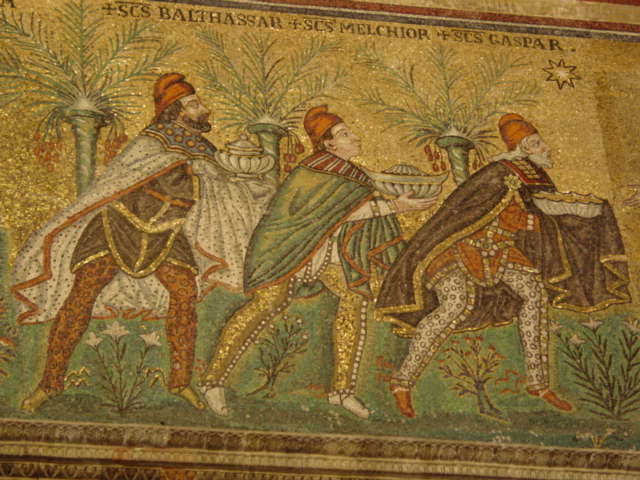
Kaspar is very probably Gaspar, the Persian among the Three Wise Men, who have no names at all in the Bible, although they do have names on the famous mosaics of Ravenna in Italy.

Or is he Caspar the Friendly Ghost of American cartoon fame? The idea suffers cruelly from the fact that this particular Caspar was never explicitly associated with Iran, and as if that were not enough there is one huge & pesky chronological conundrum.
Philo is the very well known philosopher of exactly that name, who was indeed a native son of Alexandria who happily married Athens to Jerusalem in his thinking. Unlike most of the other attendees, he actually was a contemporary of Jesus.
Until today I had always believed Apollo was a god and never even imagined he might be a human sage. I stand corrected.
Ashbina is a bit of a mystery, although I'm thinking it could be related to the Aśvins maybe. But they weren't Assyrians, now were they?
Believe what you want. But let's try and keep it believable. Holiday cheers!
An afterthought
Gideon Jasper Richard Ouseley (1835-1906 CE) was an interesting contemporary of Rev. L. Dowling and N. Notovich. I don't believe the three of them have ever been considered as a group, although I think they should be, at least as regards the Jesus + Tibet connection. Ouseley was a Lisbon-born Irish cleric, became a priest in 1870 in the Catholic Apostolic Church, although eventually excommunicated. He waged a life-long crusade for universal abstinence from meat, tobacco and alcohol. What is more relevant and to the point here, he claimed to have obtained, in 1881, through spiritistic means, meaning dreams and visions, the original document behind the Four Gospels. This came to him in the form of an Aramaic manuscript that had been placed for safekeeping in a Tibetan monastery by Essenes (note that, in books published in the 1880's — the heydey of the early Theosophical Society — Arthur Lillie had already argued that Jesus was *really* an Essene, and that the Essenes were *really* Buddhists). Ouseley himself never claimed to have traveled to Tibet, and neither did his Jesus. He called this visionary document The Gospel of the Holy Twelve, The Gospel of the Nazarenes, among still other names. This new Gospel "expounds the doctrines of Christ on universal compassion, vegetarianism and kindness to animals (involving abolition of animal sacrifices)." It was published in 1904. He wrote several other books, which seem not to be so well known, including one on cosmic rays, auras, and healing with colors. He was closely associated with the anti-vivisectionist and occultist writers Anna Kingsford and Edward Maitland. Ouseley, Dowling and Notovich may have had quite different motives. Dowling's Jesus traveled to Tibet with a mission to read his way through a library and to learn from Meng-tse some updated rites suited to modern times. Notovich, of Russian Orthodox background, wanting his story to be believed, denied having any motives, but at times you can see his 'rationalism' shining through, in his expressions of doubt about the resurrection of Jesus and the like. Ouseley's Jesus never went to Tibet. It was His original and uncorrupted gospel — one that has Jesus preaching Ouseley's pet ideas — that went there. In general all three wanted to 'document' a new truth about Jesus and/or the teachings of Jesus by recovering texts from a safe place, one generally deemed inaccessible, which to their minds meant Tibet (both Tibet and Ladakh in the case of Notovich). All three — and Lillie, too (although he is renowned for opposing the Theosophical Society) — supply, each in his way, a counter-narrative to the usual accounts of Christian origins. If only for that reason they were bound to persuade some of their readers, to whom it mattered not at all that the author-revealers knew next to nothing about Tibet. Neither did it matter that the 'mysteries' they located there have hardly anything at all to do with the real mysteries (not to mention beauties, inspirations, truths) to be found there, while having very much to do with broad religio-cultural arguments then (and, OK, now) raging in and among Euro-American minds.

See and hear and read more:
John Buescher, Jesus in Tibet, and Other Tales from the Dawn of the Aquarian Age. Search for it at The Tibetan & Himalayan Digital Library, since my connection is unreliable at the moment. This is a video version of a lecture given in honor of the retirement of Prof. Jeffrey Hopkins. This is your best place to find out more about the lives and wives of Levi H. Dowling. The Reverend Dowling was actually living in L.A., and not in Indianapolis as I suggested above, having long left Indiana behind along with his minister's work with The Church of Christ, when he "transcribed" the Aquarian Gospel. Also fascinating to learn that he had an associate in L.A. named Frederick Oliver who channeled an entity who called himself "Phylos the Tibetan." This is wonderful news.
Levi H. Dowling, The Aquarian Gospel of Jesus the Christ, first published in 1908. Online versions are everywhere.
Arthur Lillie (b. 1831), Buddhism in Christendom, or, Jesus, the Essene, first published in 1887. A PDF of the original publication may be downloaded without charge here.
The Lost Years of Jesus. Look here, where you will find a useful timeline, as well as some alternatives to the alternative views. Don't miss Jesus with long blonde hair, headband, shepherd crook and Torah scrolls hiking amidst the yaks. 21st-century imaginary art at its best.
The Lost Years of Jesus: Was Jesus in Tibet? For this brief clip produced by EVTV, including hugely entertaining interviews with Glenn Kimball, author of Hidden Stories of the Childhood of Jesus, and with John Hogue, author of Messiahs: Visions & Prophecies, press here firmly.
K, The Missing Gospel. The whole Jesus-in-Tibet (& Kashmir) myth picked over and reified through digital effects in a forthcoming indie movie. Press here. But look here too! The announcement for this just-linked low-budget production was already nominated for "Worst News of the Week" back in September. A factoid movie for your factoid people could spell box-office success, unfortunately.
The Gospel of the Nazarenes, translated from the original Aramaic by Rev. Gideon Jasper Richard Ouseley M.A. Press here.
Charles Francis Potter, The Lost Years of Jesus Revealed. I read this book as a young person and was very impressed by it. I wonder what could have happened to my copy? Any idea about that, Kim? Jerry?
Robert M. Price, Jesus in Tibet: A Modern Myth, The Fourth R, vol. 14, no. 3 (May 2001). Press here.
Sam van Schaik, Christianity in Early Tibet. Found at the blogsite "Early Tibet." Press here.
Tibet Talk (Blog), The Lost Years of Jesus in Tibet. Press here.
Geza Vermes, Who's Who in the Age of Jesus, Penguin Reference Library (London 2005).
-
04-04-2009, 09:31 AM #146
For all those skeptics who don't believe that Jesus had traveled to India and Tibet, then that's not my problem anymore. That's your problem guys. I have already done my homework.
If Buddha had a complete biography, then why did Jesus lack a complete history of his life in the bible? The answer is simple. The Bible is not complete when it comes to Jesus' life.
Last edited by regnauld; 04-04-2009 at 09:36 AM.
-
04-04-2009, 11:58 AM #147C.I.A.

- Join Date
- Jan 2004
- Posts
- 17,303
mao bitaw sa RC, besides the bible they also believe in the apostolic tradation which started before the bible was compiled. Originally Posted by regnauld
-
04-04-2009, 01:12 PM #148Banned User
- Join Date
- May 2008
- Posts
- 6,786
murag naa pa man si jesus sa bible from 9 yrs. old to 12 yrs. old. from 12-30 hinuon kay missing in action na siya. sa akong mga nabasahan, he went to india, tibet, syria, greece, egypt, and other countries to learn and study from the Masters and Sages there.
try to read The Aquarian Gospel of Jesus the Christ.
-
04-04-2009, 04:05 PM #149Banned User
- Join Date
- Aug 2005
- Posts
- 7,244
i once heard that Jesus of that time was on a caravan.
he was with spice traders that roamed all over asia. (pasabot, asia jud ha)
-
04-04-2009, 04:43 PM #150Junior Member
- Join Date
- Mar 2009
- Posts
- 364
so,basing sa mga sources read, JC travelled all over asia..that in which includes India & Tibet..is it me? or nkabantay mo na most(if not all) teachings ni JC are in many cases like the teachings of Buddhism?? Buddhism is a much older religion than RC..if it shud be proven then i think it will explain more the travel of JC to India...and for a fact, i dnt see any wrong if it were true..^_^




Similar Threads |
|
 Posting Permissions


|