



Yes, artist's impressions can sometimes be misleading. Another good example are artist's impressions in astronomy, i.e. when NASA wants the public to be interested in say exoplanets, they hire graphic artists to depict these planets with artistic freedom, but within the bounds of what factual information the scientists have about the planet in question, but sometimes the resulting artwork is taken literally. What's even worse about the image posted above, is that it's NOT an artist's impression, but a "stylized" image depicting the nano-spider. So I'll temper this post by doing this:Originally Posted by fritzd

"Stylized" (i.e. influenced by image of "spider" and "robot") image of these Nanobots:
Artist's Impression
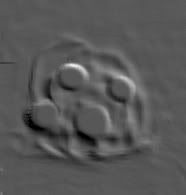
What they might actually look like under a scanning electron microscope:
So, in order to "sell" an idea well, sometimes the financiers of the scientists (and not the scientists themselves) rely on "baiting" tactics by using "nice" graphics, in order to grab public attention.
-RODION
Results 11 to 20 of 24
-
05-27-2011, 08:37 AM #11
 Re: Robotic Nano-Spiders Made of DNA Molecules
-
05-27-2011, 09:50 AM #12 Re: Robotic Nano-Spiders Made of DNA Molecules
^
Rody it's nice to know that. Reduced the amount of misconception.
+100 Info!
-
05-27-2011, 10:31 AM #13 Re: Robotic Nano-Spiders Made of DNA Molecules
mao na ni isulod sa mga ugat sa tawo. pastilan, mura na ni'g TRON puhon.
bitaw, it's very interesting.
-
05-27-2011, 12:58 PM #14C.I.A.


- Join Date
- Oct 2008
- Posts
- 2,738
Re: Robotic Nano-Spiders Made of DNA Molecules
kuyaw kng maka tambal nig cancer. mao na niy bakuna para sa cancer
-
05-27-2011, 02:58 PM #15Senior Member

- Join Date
- Feb 2006
- Posts
- 633
Re: Robotic Nano-Spiders Made of DNA Molecules
Indeed. Originally Posted by rodsky
 Anyway, I think they used AFM (atomic force microscopy) based on their original publication. I think they didn't want their samples to die right away if they used SEM. hehe
I'm no biologist nor chemist but their work is really quite fascinating. I haven't read the whole paper yet but they can control the movement of their MOLECULAR ROBOT (a more scientific term, hehe). If it's published in Nature then it is more than something.
Taken from nature09012.pdf

-
05-27-2011, 03:58 PM #16C.I.A.

- Join Date
- Dec 2003
- Posts
- 5,993
Re: Robotic Nano-Spiders Made of DNA Molecules
the stylized image really attracts attention.
-
05-27-2011, 09:23 PM #17C.I.A.

- Join Date
- Feb 2009
- Posts
- 3,613
Re: Robotic Nano-Spiders Made of DNA Molecules
Kuyaw sad ni og pataka lang unya ni sila og detect..
-
05-29-2011, 12:28 AM #18Junior Member

- Join Date
- Feb 2011
- Posts
- 38
Re: Robotic Nano-Spiders Made of DNA Molecules
dili na tinuod..lisud pa pagbuhat ug nano size biomechanical device...ug ma control pa gyud ...still scifi..
-
05-29-2011, 02:16 AM #19 Re: Robotic Nano-Spiders Made of DNA Molecules
wow, nice invention nasad nga makatabang sa atong inadlawng panginabuhi..
-
06-09-2011, 04:51 PM #20Junior Member
- Join Date
- Jan 2011
- Posts
- 241
Re: Robotic Nano-Spiders Made of DNA Molecules
mura man og sa G.I. Joe...mga "Nanomites"...
 The spider-like robot is really built from DNA but it is still from from real robots that you can really control or like the artist's impression posted by the TS.


 Reply With Quote


Similar Threads |
|
 Posting Permissions


|