


The Largest Bacteria in the World
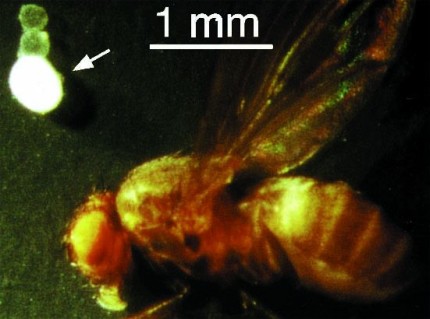
The largest prokaryote, Thiomargarita namibiensis compared to a fruit fly,
Drosophila. A single cell can reach a diameter of 0.75 mm.
THE BIGGEST bacteria ever known have been discovered off the African coast. They consist of cells up to 0.75mm in diameter - equivalent to seven pages of a book seen edge-on.
The find was made by German, Spanish and US researchers sampling sediment off Namibia. Thiomargarita namibiensis, which means "sulphur pearl of Namibia", is 100 times larger than the previous record for bacterial size. "When I told them, my colleagues didn't believe me," said Heide Schulz, of the Max Planck Institute for Marine Microbiology, who discovered the organisms.
If the largest Thiomargarita were a blue whale, an ordinary bacterium such as E. coli would be slightly smaller than a newborn mouse. The previous largest known bacterium, which lives in the gut of surgeon-fish, would on this scale be as big as a lion.
Some 98 per cent of the cells consist of a liquid container, or vacuole, for storing solutions that allow the bacterium to "hold its breath" for up to three months while it waits for the correct conditions to arise, according to the report in the journal Science. The cells live in sediment, which is rich in hydrogen sulphide, the "rotten-egg" gas. They can store both that gas and nitrates - oxides of nitrogen - from seawater.
The latter are stored in the vacuole. The cell generates energy from a reaction between the sulphide and the nitrates. But because nitrate- rich seawater rarely reaches the sediment, the cells have to be able to store the chemicals as they wait for storms to stir up the sediment and provide new "food". The importance of the role of T. namibiensis lies in that ability to oxidise hydrogen sulphide, which is produced in enormous quantities by other bacteria. Potentially, it can poison all sorts of life: hundreds of people died in an African town on the shores of a lake when a cloud of hydrogen sulphide was released from sediment on the lake's bottom.
But because it can transform the gas into less poisonous forms, T. namibiensis plays an important role for aquatic and possibly even land life. "It couples the sulphur and nitrogen cycles, perhaps to a degree not previously given enough credence," said Mr Schulz.
Cycling of nitrogen from a gas to nitrates and back again, and of sulphur from sulphides to sulphates is a key to development of life on Earth. Micro-organisms play a key role by making chemical by-products available from all those processes which can then be used by all other organisms.
Results 151 to 160 of 259
-
11-12-2010, 02:07 PM #151C.I.A.

- Join Date
- Jun 2009
- Posts
- 2,887

-
11-12-2010, 02:13 PM #152C.I.A.
- Join Date
- Jun 2009
- Posts
- 2,887
Giant earthworms
The giant Gippsland earthworm, Megascolides australis, is one of Australia's 1,000 native earthworm species. These Giant earthworms average at 100 cm long and 2 cm in diameter and can reach 3 m in length.[1] They have a dark purple head and a blue-grey body.
They live in the subsoil of blue, grey or red clay soils along stream banks and some south or west facing hills of their remaining habitat which is in Gippsland in Victoria, Australia.
These worms live in deep burrow systems and require water in their environment to respirate. These worms rarely leave their moist burrows. They have relatively long life spans for invertebrates and can take 5 years to reach maturity. They breed in the warmer months and produce large egg cocoons which are laid in their burrows. When these worms hatch in 12 months they are already 20 cm long.
They can sometimes be heard in their habitat making gurgling sounds as they move underground.
Located near the town of Bass is the Giant Earthworm Museum. This building allows tourists to crawl through a magnified replica of a worm burrow and a simulated worm's stomach. Displays and educational material on the Giant Gippsland earthworm and other natural history of Gippsland are featured.


-
11-12-2010, 02:20 PM #153C.I.A.
- Join Date
- Jun 2009
- Posts
- 2,887
Return of the giant jellyfish
13 Nov 2007
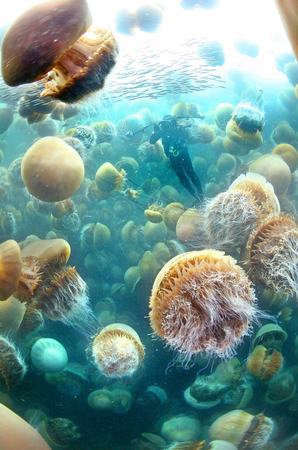
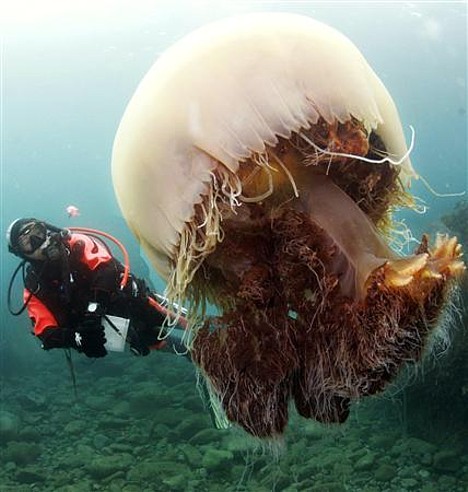 To the delight of divers, and to the chagrin of fishermen, the swarms of giant Echizen kurage jellyfish (Nomura's jellyfish) that invade the coast of the Sea of Japan each autumn are back.
These photos were taken 5 meters underwater just offshore from the coastal town of Echizen in Fukui prefecture, where the jellyfish mobs began to arrive about a month later than normal.
Manabu Nakamata, a 38-year-old diver from Nagoya and an admirer of the monster jellyfish, says, "They are surprisingly hard to the touch. They are big, and extremely impressive." Big indeed -- Echizen kurage can grow up to 2 meters (6 ft. 7 in.) in diameter and weigh up to 200 kilograms (440 lb.) each.
The local fishermen, however, are not impressed. Each year, the giant jellyfish wreak havoc on the fishing industry by destroying nets and crushing, poisoning and sliming other fish in the catches. In the latest move in the war on jellyfish, Fukui prefecture is developing new and efficient weapons designed to pulverize those that threaten their shores.
Based on what they have seen so far, the researchers warn this year's onslaught of Nomura's jellyfish (Nemopilema nomurai, or Echizen kurage in Japanese) could deliver a massive blow to Japan's fishing industry, rivaling even the devastating 2005 deluge that caused tens of billions of yen (hundreds of millions of dollars) in damage nationwide.
The surveys are being conducted by a team led by Shinichi Ue, a professor of biological oceanography at Hiroshima University who also chairs a government research committee tasked with developing technology to predict and control jellyfish explosions. Ue has been monitoring the population density of Nomura's jellyfish in the southern Yellow Sea and northern East China Sea since 2006.
Between June 20 and 24, 2009, Ue's team observed numerous specimens with umbrellas measuring 10 to 50 centimeters across, and they calculated an average distribution of 2.14 jellyfish per 100 square meters. This figure is more than 200 times higher than the 0.01 jellyfish per 100 square meters observed in the same region in 2008. It is also nearly triple the 0.77 jellyfish per 100 square meters observed in 2007, when the fishing industry in the Sea of Japan suffered widespread damage.
To make matters worse, this year's swarms appear to be taking a more direct and southerly route to Japan, unlike in 2007 when the jellyfish appeared to take a more northerly route, approaching the Sea of Japan coast from the direction of Korea. According to the researchers, the ocean currents could bring unprecedented numbers of Nomura's jellyfish to Japan's Pacific coast, which typically sees far fewer of the monster blobs than the Sea of Japan coast.
Nomura's jellyfish typically bloom in Chinese waters in spring, and they mature into adults as ocean currents slowly carry them north. By July, when the first swarms reach Tsushima (just north of the southern island of Kyushu), many jellyfish are as large as sumo wrestlers. At this size, it only takes about 5 or 10 of them to destroy a commercial fishing net.
In addition to damaging nets, the giant jellyfish are blamed for killing other fish with their venom, lowering the quality and quantity of catches, increasing the risk of capsizing trawlers, and stinging fishermen.
In 2005, the fishing industry reported over 100,000 cases of jellyfish-related damage nationwide. At the peak of the invasion that year, an estimated 300 to 500 million monster jellyfish passed through the Tsushima Strait into the Sea of Japan each day.


A slimy legend of the deep has become a pest for Japanese fishermen.
The jellyfish the size of sumo wrestlers, more commonly found in Chinese and Korean waters, are now proliferating off Japan's coast.
Japanese fishermen have gathered in Tokyo to discuss solutions to vast numbers of Echizen kurage, or Nomura's jellyfish, which have grown a hundredfold in some areas of Japan since July.
The massive sea creatures, which can grow two metres wide and weigh up to 220 kilograms, are clogging and ripping fishing nets, causing havoc for fishermen who have to spend hours hacking them out of their nets.
The fishermen's catch is also being poisoned by the invertebrates toxic stingers.
While there are records of people dying from the noxious sting from the jellyfish, reports of serious human injury are rare.
National Geographic News says the invasion has prompted a series of studies by the Japanese government to research the animal, whose mating and migration habits are poorly understood.
It says scientists have speculated that the jellyfish are drifting from China's Yangtze River Delta, where unusually heavy rains may be pushing the jellyfish to Japan.
Space caramel made from giant jellyfish
16 Sep 2009
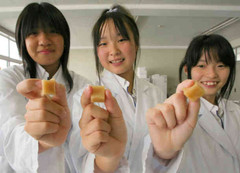
In the latest move in Japan's war on giant jellyfish, high school students in the town of Obama have developed a new type of caramel candy made from the enormous sea creatures -- and they are offering it up as a snack for astronauts in space.
The enterprising Obama Fisheries High School students have requested the Japan Aerospace Exploration Agency (JAXA) to place their chewy treat on the official menu for astronauts aboard the International Space Station. The space agency, which appears to be entertaining the proposal, is reportedly sending a representative to the school tomorrow (September 17) to evaluate the candy.
Described as having a sweet and salty flavor, the caramel's ingredients include sugar, starch syrup, and jellyfish powder, which is obtained by boiling the jellyfish down to a thick paste, drying it, and grinding it into fine particles. The most recent batch of caramel uses powder from Nomura's jellyfish snared last month in fixed fishing nets in nearby Wakasa Bay. The bay is located in Fukui prefecture, which has been among the areas hardest hit by the giant jellyfish swarms in recent years.
 The students began cooking with Nomura's jellyfish three years ago, after a NASA-designed food safety management system was installed at the school. In 2006, after the school developed a method for processing giant jellyfish into an edible powder, a local company began using it as an ingredient in their jellyfish cookies.
Since then, the students have been searching for new ways to use their jellyfish powder. They are hoping to benefit from the recent raw caramel craze sweeping Japan.
-
11-12-2010, 02:22 PM #154C.I.A.
- Join Date
- Jun 2009
- Posts
- 2,887
Giant Animals Still Roam the Earth
A couple of years ago, some 11 year old boy killed the largest wild boaranyone has ever seen. The thing is unbelievably massive. Actually, to be exact, it was "1,051 pounds and measured 9-feet-4 from the tip of its snout to the base of its tail". Seriously? No one notice this thing walking around? It's bigger than my car. And he killed it with a hand gun? Who goes hunting with a hand gun? After reading about this pig-monster, I could think about only 1 thing: how sick of eating pork this kid's family is going to become. Some more pictures of such giant animals after the jum


Last edited by cromagnon; 11-12-2010 at 03:22 PM.
-
11-12-2010, 02:46 PM #155C.I.A.

- Join Date
- Jun 2005
- Posts
- 2,430
Tongue-Eating parasitic louse (Cymothoa exigua)
i remember this thing before when i clean a fish, it's under the fish's gills.
malabay gyud nako ang isda basta makakita ko ani, it's really creepy to see.
mao karon, dili ko mokuha ug gills sa isda. ako nalang palimpyohan daan sa tindera.
abi nako pagkaon to sa isda, but why inside the gills?
-
11-12-2010, 02:59 PM #156C.I.A.
- Join Date
- Jun 2009
- Posts
- 2,887
parasite man , they started living sa gils when they are still a larvae till they grew bigger....abi nako pagkaon to sa isda, but why inside the gills?
and eat the tounge... cla mo puli
-
11-12-2010, 03:04 PM #157C.I.A.
- Join Date
- Jun 2005
- Posts
- 2,430
yes, it's clear now for me. how much more kung adult na and it's bigger, ewwwwww! Originally Posted by cromagnon

-
11-12-2010, 04:01 PM #158C.I.A.
- Join Date
- Jun 2009
- Posts
- 2,887
maybe it leaves the fish swarm the eggs to another gills and dies...
-
11-13-2010, 06:07 AM #159C.I.A.

- Join Date
- Sep 2010
- Posts
- 6,019
daku.a anang jellyfish uy.! wa uruy na ni kirig ang diver sa.!
tinuud nang "Mongolian Death Worm".?
-
11-13-2010, 03:05 PM #160Senior Member

- Join Date
- Nov 2010
- Posts
- 562
This is really an awesome thread. Very informative

Dako-a sa earthworms sa, mura naman na ug bitin


 Reply With Quote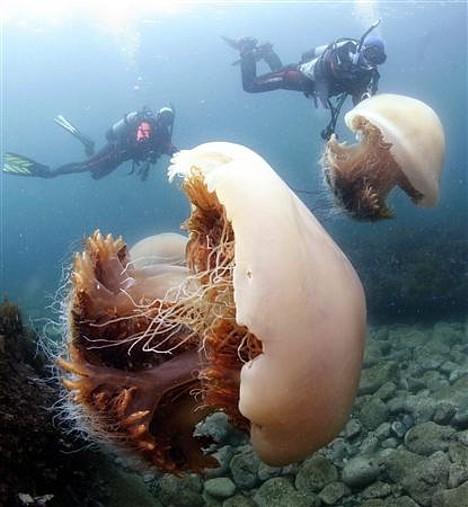
 Nomura's jellyfish, 2007 (Photo: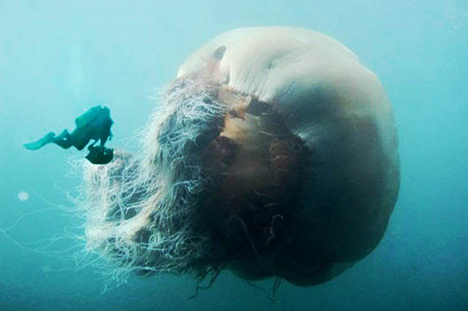


Similar Threads |
|
 Posting Permissions


|