


Glyptodon, an Ancient Armadillo
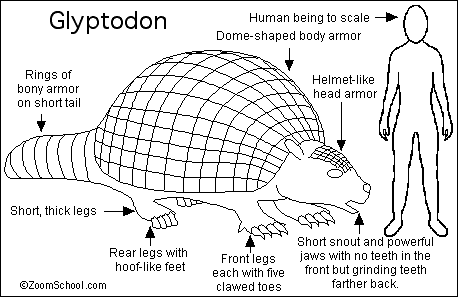
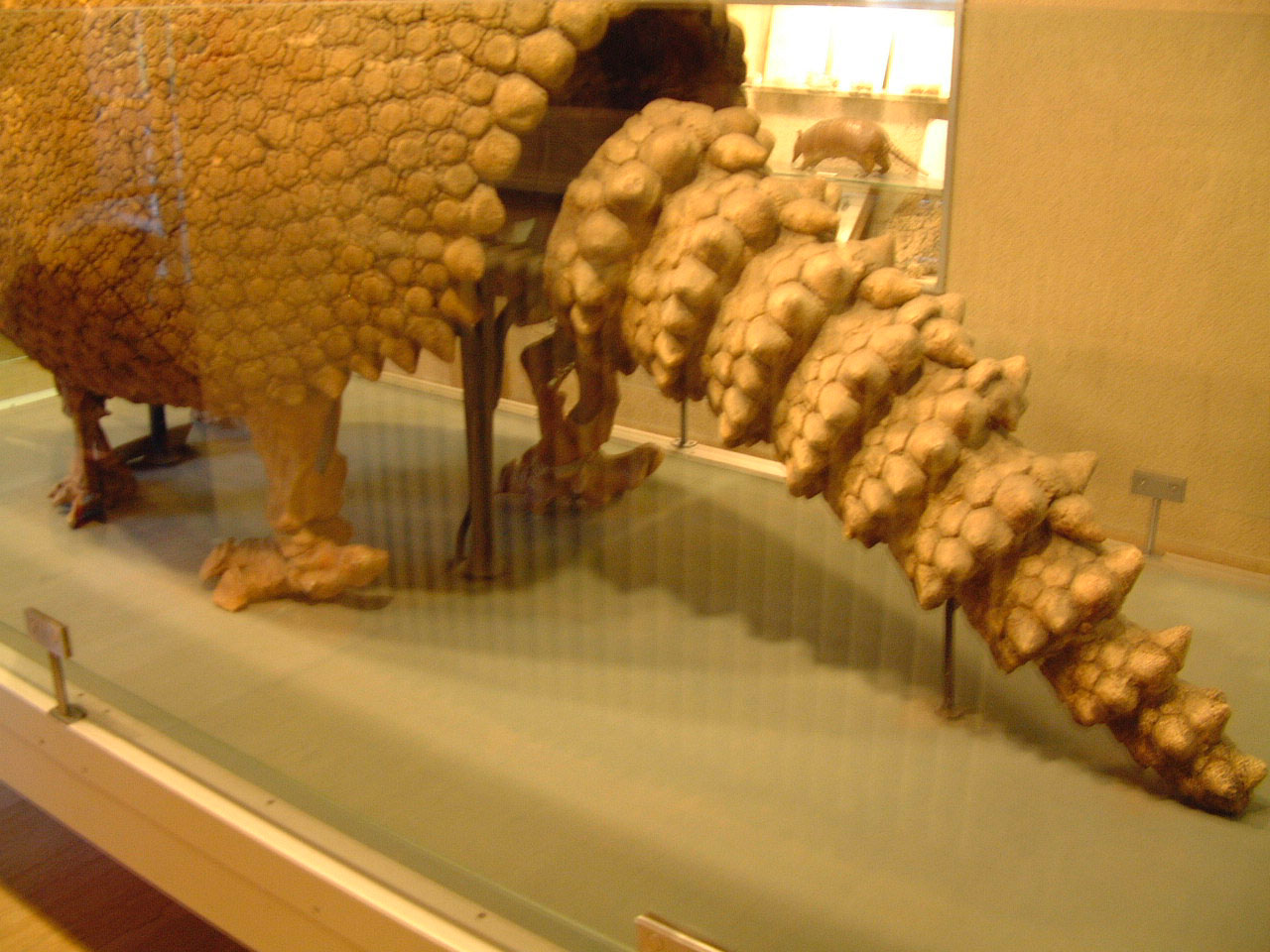
Glyptodon (pronounced GLIP-toh-don) was one of the biggest ancient armadillos (belonging to the family Glyptodontidae). Fossils of this car-sized mammal have been found in Argentina, South America. Glyptodon (meaning "carved tooth") was named by paleontologist R. Owen in 1839. These herbivores (plant-eaters) may have been preyed upon by saber-toothed cats. Anatomy: This well-armored animal had heavy, dome-shaped body armor, helmet-like head armor, and rings of bony armor on its short tail. This mammal had four short, thick legs; the front feet each had five clawed toes and the rear feet were more hoof-like. It had a short snout and powerful jaws, with no teeth in the front of the mouth, but had grinding teeth farther back in the jaws. It was about 10 feet (3 m) long and 5 feet (1.5 m) tall.
When Glyptodon Lived: Glyptodon lived in the Ice Ages, during the Pleistocene (between 2 million and 15,000 years ago).
Classification: Class Mammalia (mammals), Order Edentata (anteaters, sloths, and armadillos), Family Glyptodontidae (armadillo-like animals), Genus Glyptodon.
Size and Weight:
About 10 feet long and one ton
Diet:
Plants
Distinguishing Characteristics:
Huge, armored dome on back; short head and neck
About Glyptodon:
One of the most distinctive--and comical-looking--creatures of prehistoric times, Glyptodon was essentially a dinosaur-sized armadillo, with a huge, round, armored carapace, stubby, turtle-like legs, and a blunt head on a short neck. As many commentators have pointed out, this prehistoric mammal looked a bit like a Volkswagen Beetle, and tucked up under its shell it would have been virtually immune to predation (unless an enterprising predator figured out a way to flip it onto its back and dig into its soft belly). The only thing it lacked was a clubbed, spiked tail, a feature evolved by its close relative Doedicurus.
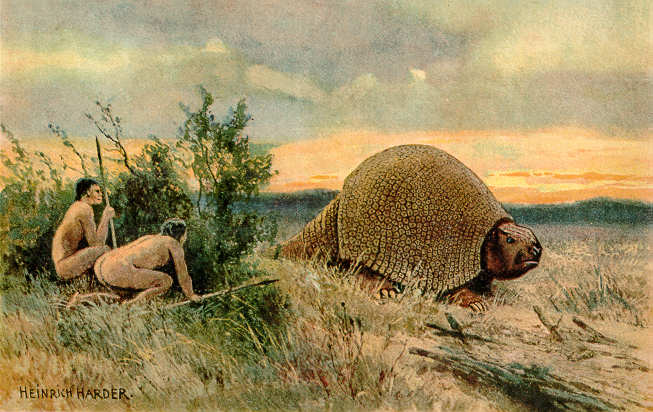
Glyptodon survived well into early historical times, only going extinct about 10,000 years ago, along with most other megafauna of the Ice Age (such as Diprotodon, the Giant Wombat, and Castoroides, the Giant Beaver). This huge, slow-moving armadillo was probably hunted to extinction by early humans, who would have prized it not only for its meat but also for its roomy carapace--there's evidence that the earliest settlers of South America sheltered from the snow and rain under Glyptodon shells!
Results 131 to 140 of 259
-
08-24-2010, 10:11 PM #131C.I.A.


- Join Date
- Jun 2009
- Posts
- 2,887

-
08-24-2010, 10:18 PM #132C.I.A.
- Join Date
- Jun 2009
- Posts
- 2,887

Pictures: © BBC 2001, distributed under license from BBC Worldwide Limited |
Doedicurus
Doedicurus was a glyptodont, related to both living armadillos and sloths and anteaters. The size of a small car, with an armored carapace and spiked tail of solid bone, it grazed the grasslands of South America. Its tail was a vicious weapon, probably used for clobbering predators or other Doedicurus.

Pictures: © BBC 2001, distributed under license from BBC Worldwide Limited |
Propalaeotherium
These small, cat-sized forest animals are among the earliest known horses. They had four toes on each of their front feet and three on each of their back feet, and they walked on pads, like dogs.
PRONUNCIATION: PRO-PAY-LEE-OH-THEE-REE-UM
LIVED: 49 – 43 million years ago
SIZE: Two species: 12 to 14 inches or 22 to 24 inches at the shoulder
FACT: Herbivorous, browsing leaves and fallen fruit
MEANING: Before Palaeotherium
CLOSEST LIVING RELATIVE: Horses

Pictures: © BBC 2001, distributed under license from BBC Worldwide Limited |
Megatherium
This bear-like creature was so big it could rest its chin on top of a double-decker bus; its shaggy hair hid skin as tough as chain mail, and its claws were the size of daggers. These claws meant that it could not put its feet flat on the ground and so, like a modern anteater, it had to walk on the sides of its feet. Even more extraordinary, its footprints show that it walked mainly on its hind legs.
PRONUNCIATION: MEG-AH-THEER-EE-UM
LIVED: 1.9 million – 8,000 years ago
SIZE: Up to 20 feet long
FACT: Herbivorous, eating vegetation and possibly scavenging meat
MEANING: Giant beast
CLOSEST LIVING RELATIVE: Tree sloths
RANGE: North and South America

Pictures: © BBC 2001, distributed under license from BBC Worldwide Limited |
Megaloceros
Often confusingly called the "Irish elk," this creature — found across Europe — is technically a deer. Its huge antlers were once thought to have been its downfall; the thinking was that they could have grown so large that either the animal could no longer lift its head or they'd become entangled between trees. Now, though, Megaloceros is thought to have been the victim of sudden climatic changes.
PRONUNCIATION: MEG-AH-LOSS-ER-OS
LIVED: 400,000 – 9,500 years ago
SIZE: 7 feet tall at the shoulder
FACT: Herbivorous, feeding on grass and vegetation
MEANING: Giant antler
CLOSEST LIVING RELATIVE: Fallow deer
RANGE: Europe, North Africa and Asia

Pictures: © BBC 2001, distributed under license from BBC Worldwide Limited |
Leptictidium
These strange hopping animals, resembling a cross between a shrew and a large cat, are part of a group that survived the great extinction at the end of the Cretaceous. They became extinct themselves once the lush tropical forests started to disappear about 40 million years ago.
PRONUNCIATION: LEP-TIK-TID-EE-UM
LIVED: 50 – 40 million years ago
SIZE: 35 inches long, including the tail
FACT: Carnivorous, consuming small lizards, small mammals and invertebrates
MEANING: Delicate weasel
CLOSEST LIVING RELATIVE: None; died out
RANGE: Europe

Pictures: © BBC 2001, distributed under license from BBC Worldwide Limited |
Gastornis
A successful and ferocious descendant of the dinosaurs, Gastornis was one of the largest animals of its time: a meat-eating bird as tall as a grown man. While it has been the subject of some debate, the latest research suggests Gastornis used its enormous beak to kill prey, gripping an animal in its beak to paralyze it and then shaking its head to break the prey's spine.
PRONUNCIATION: GAS-TOR-NIS
LIVED: 56 – 41 million years ago
SIZE: 5.7 feet tall
FACT: Carnivorous, either hunting or scavenging
MEANING: Named after Gaston Planté, who found the first remains
CLOSEST LIVING RELATIVE: Birds
RANGE: Europe

Pictures: © BBC 2001, distributed under license from BBC Worldwide Limited |
Basilosaurus
With a skull as long as a sofa and a total body length equivalent to that of three elephants, this early whale was at the top of the underwater food chain. To maintain its incredible weight — it was as heavy as two tanks — Basilosaurus was an eating machine that could swallow sharks whole. Fossils also show a reminder of its land-animal ancestors: a pair of tiny back legs.
PRONUNCIATION: BASS-IL-OH-SAWR-US
LIVED: 40 – 36 million years ago
SIZE: 66 feet long
FACT: Carnivorous, feeding on fish, sharks, mollusks and cetaceans
MEANING: King lizard
CLOSEST LIVING RELATIVE: Whales
RANGE: North America and North Africa

Pictures: © BBC 2001, distributed under license from BBC Worldwide Limited |
Andrewsarchus
A rhino-sized, wolf-like carnivore, Andrewsarchus is actually a relative of our familiar hoofed animals and a distant relative of the early whale, Basilosaurus. Its fossils are usually found around water, and as single specimens, so it seems that these animals might have been solitary scavengers along riverbanks and tide lines.
PRONUNCIATION: AND-ROOZ-ARK-US
LIVED: 60 – 32 million years ago
SIZE: 6 feet tall and 16 feet long, with a skull around 33 inches long
FACT: Weighed more than a car, and stretched the length of two
MEANING: Andrews' beast (after paleontologist Roy Chapman Andrews, the role model for Indiana Jones)
CLOSEST LIVING RELATIVE: Whales and hoofed animals
RANGE: Eastern Asia

Pictures: © BBC 2001, distributed under license from BBC Worldwide Limited |
Hyaenodon
These animals were very successful predators from a group known as creodonts. Their skulls show that they had incredibly strong jaws, and the males show grinding marks on their teeth very much like those of modern animals that use the noise of grinding teeth as an intimidation display.
PRONUNCIATION: HI-EE-NOH-DON
LIVED: 41 – 25 million years ago
SIZE: 4.6 feet tall at the shoulder and 10 feet long, plus tail
FACT: Carnivorous, with crushing jaws
MEANING: Hyena-toothed
CLOSEST LIVING RELATIVE: None; died out
RANGE: Asia and North America
-
08-25-2010, 11:30 AM #133C.I.A.

- Join Date
- Jun 2005
- Posts
- 2,430
naa napud ko nakat-onan. nindot gyud magsunod ani nga thread.
-
08-25-2010, 10:52 PM #134C.I.A.
- Join Date
- Jun 2009
- Posts
- 2,887
hehe tnx2 - no problem bay ..
nature never cease to amaze us...
-
08-26-2010, 11:57 AM #135Elite Member

- Join Date
- Aug 2010
- Posts
- 407
love this thread.. very educational...

-
08-27-2010, 12:33 PM #136Junior Member

- Join Date
- Jul 2010
- Posts
- 411
mee too!!! i like things that are very informative...

-
11-03-2010, 02:01 PM #137
very nice! lingawa nko uy!.. keep them coming guys.
-
11-03-2010, 11:25 PM #138C.I.A.
- Join Date
- Jun 2005
- Posts
- 2,430
i miss this thead...wala pa lain update?
-
11-04-2010, 02:28 AM #139C.I.A.
- Join Date
- Jun 2009
- Posts
- 2,887
Usa na kabaranggay ang maka kaun anang - Kalamariss
-
11-04-2010, 02:29 AM #140C.I.A.
- Join Date
- Jun 2009
- Posts
- 2,887
aw , thnx puhon2 .... hehee Originally Posted by mybuuz


 Reply With Quote
Similar Threads |
|
 Posting Permissions


|