


say english anang siloy bro?Originally Posted by thesatins

hehe kikik!!! ungo mana bae
Results 171 to 180 of 541
-
01-14-2010, 10:54 AM #171

-
01-14-2010, 12:51 PM #172
I strongly DISSAGREE that this is not related to Cobras (genus Naja). This is by all means is a REAL cobra. From the genus Naja of the Elapidae family, could'nt be more real.. Originally Posted by moy1moy1
Just to be commonly trivial... By it's english name alone "King", called as such because it's the largest cobra and it's the longest venomous snake. By it's scientific name "Ophiophagus hannah", means: it's a "King Snake-eater". ("Ophio" = snake; "phagus" = mouth, eat; "hannah" = king)...Last edited by herp_doctor; 01-14-2010 at 01:30 PM.
-
01-14-2010, 06:48 PM #173
sir.. I was about 2 edit that sir.. . . sorry 4 the mistake but please just PM ur concerns.. Originally Posted by herp_doctor


-
01-15-2010, 05:57 PM #174Junior Member

- Join Date
- Jul 2007
- Posts
- 43
black shama ang english sa siloy bai..
The Black Shama (Copsychus cebuensis) is a species of bird in the Muscicapidae family. It is endemic to the island of Cebu, Philippines.
Its natural habitats are subtropical or tropical moist lowland forests, subtropical or tropical moist shrubland, and plantations.It has been sighted in several locations all across the island, the most important sites being the Central Cebu Protected Landscape, the forests of Alcoy and Argao, and the shrublands of Casili, Consolacion. It is threatened by habitat loss.
Got this from wikipedia.
-
01-15-2010, 09:14 PM #175C.I.A.

- Join Date
- Feb 2008
- Posts
- 2,097
sayanga sa ato mga birds woe!! nooooooooooooooooo
-
01-16-2010, 09:58 AM #176C.I.A.

- Join Date
- Mar 2009
- Posts
- 6,975
Originally Posted by thesatins
makit.an ni nako kada adlaw sa cebu daily inquirer bro....hehehe...si siloy....ehhehe
-
01-16-2010, 07:17 PM #177
Dragonet #1 : Mandarin fish
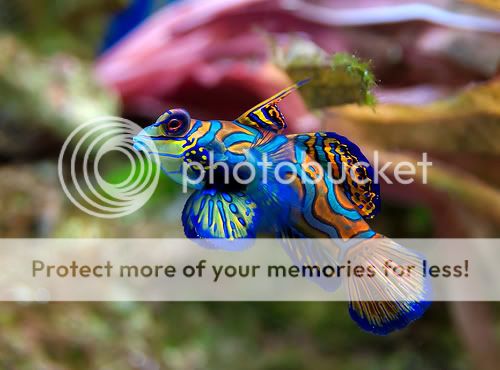
Com.name: mandarin goby, mandarin blenny, mandarin fish, dragonette, mandarin dragonet
Sci.name: Synchiropus splendidus
Classification: Fish
Family: Dragonet
Location/Origin:
The mandarinfish is native to the Pacific, ranging approximately from the Ryukyu Islands south to Australia. (refer to map).
Description:
To date, S. splendidus is one of only two animal species known to have blue colouring because of cellular pigment, the other being the closely related LSD-fish (S. picturatus). The name "cyanophore" was proposed for the blue chromatophores, or pigment-containing and light-reflecting cells. In all other known cases, the colour blue comes from thin-film interference from piles of flat, thin and reflecting purine crystals. Mandarinfish are reef dwellers, preferring sheltered lagoons and inshore reefs. While they are slow-moving and fairly common within their range, they are not easily seen due to their bottom-feeding habit and their small size (reaching only about 6 cm). They feed primarily on small crustaceans and other invertebrates. Based on the gut analyses of 7 wild fish Sadovy et al. (2001) determined that the mandarinfish has a mixed diet that harpacticoid copepods, polychaete worms, small gastropods, gammaridean amphipods, fish eggs and ostracods. In the wild, feeding is continuous during daytime; the fish peck selectively at small prey trapped on corral substrate in a home range of many square meters Despite their popularity in the aquarium trade, mandarinfish are considered difficult to keep, as their feeding habits are very specific. Some fish never adapt to aquarium life, refusing to eat anything but live amphipods and copepods (as in the wild), though individuals that do acclimatize to aquarium food are considered to be quite hardy and highly resistant to diseases such as ich. They cannot contract the disease Ichthyophthirius because they do not have the skin type that this common aquarium disease affects.
Reference:
Mandarinfish - Wikipedia, the free encyclopedia
-
01-16-2010, 07:17 PM #178
Dartfish #1 : Purple firefish
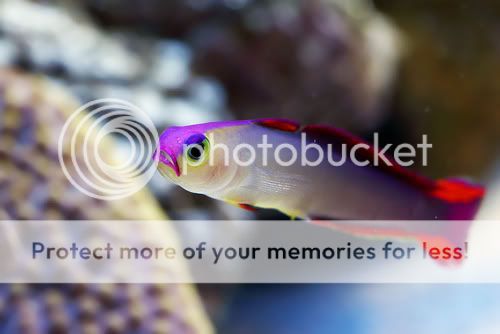
Com.name: purple fire fish, elegant firefish, purple fish
Sci.name: Nemateleotris decora
Classification: fishes
Family: dartfish
Location/Origin:
This species is found in the Indo-West Pacific, from Mauritius to Samoa, north to Ryukyu Islands, and south to New Caledonia, from 25–70 metres ( ft) in depth. It is found over hard, open bottoms of reefs and sandy patches, as well as deeper coastal outer reef drop-offs. (refer to map).
Description:
This fish is popular in reef aquariums and is resistant to disease. These fish are relatively docile and will not attack tankmates where kept in a suitably sized aquarium; however, if kept in confined quarters these fish may squabble over territory. Firefish are commonly kept in nano reef aquariums. Firefish are prolific leapers. Thus, an aquarist contemplating the acquisition of either of these species should be certain that the aquarium hood will not easily allow the firefish to leap from the tank and expire. These fish should also be provided with rockwork to hide in. This and other species of firefish are occasionally spawned in captivity. This species is often found in pairs and is monogamous. These fish feed on zooplankton, especially copepods and crustacean larvae. They will dart into holes when alarmed.
Reference:
Elegant firefish - Wikipedia, the free encyclopediaLast edited by moy1moy1; 02-10-2010 at 10:11 PM.
-
01-16-2010, 07:18 PM #179
Goby #1 : Black-ray goby
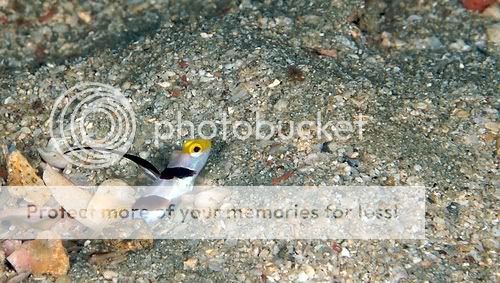
Com.name: black ray goby
Sci.name: Stonogobiops nematodes
Classification: fish
Family: goby
Location/Origin:
This goby is commonly found in the western Indo-pacific (Indonesia and the Philippines) inhabiting sandy bottoms and rocky outcrops at depths ranging from 60 to 100 feet.
Description:
The Black-ray Goby is a species of marine goby and is a member of the family of High Fin Gobies. This type of goby is also sometimes attributed the common name "Shrimp Goby" or "Watchman Goby". This is due to the interesting symbiotic relationship that these gobies can form with Randall's pistol shrimp. Adult fish can grow up to two inches in length, with the striking pointed dorsal fin becoming more raised and pronounced in adulthood. This elongated fin is the most obvious distinguishing feature between the black-ray goby and its close cousin, the yellow snout goby (S. Xanthorhinica). The fish are beautifully coloured with four diagonal brown stripes across a white body, and a distinctive yellow head. It is almost impossible for anybody less than a specialized expert in the specific field of these types of fish to discern differences between males and females of the species. This fish is very docile and poses almost no threat to any other livestock inhabiting a typical marine aquarium. This passiveness makes it a perfect tankmate for delicate species like sea horses or pipefish. In fact, it is in reality quite shy, and when first introduced into an aquarium, may take up to several weeks before it is bold enough to leave its hiding place, or bolt hole. Whilst this fish can display aggression towards other tank inhabitants by opening its mouth and "yawning" at them, this is mostly show and the goby will quickly turn tail and hide if confronted. The goby will spend most of its time hovering about two inches above its bolt hole, searching for scraps of food in the water column. If scared or startled, it will slowly retreat towards its hole. If the danger does not go away, it will dart inside at lightning speed. Mated pairs of this fish are very rare and difficult to come by. Individual males may fight if placed in a tank smaller than about 50 gallons (~200 litres). This goby, along with the others of its genus are renowned for their remarkable relationship with Randall's shrimp (or Candy-stripe pistol shrimp, Alpheus Randalli). This particular genus of goby does not associate with any other type of shrimp in the wild. The shrimp spends the day digging a burrow in the sand in which both live. Burrows usually measure up to one inch in diameter, and can reach up to four feet in length. The goby has much better eyesight than the shrimp, and, as such, acts as the watchman for both of them, keeping an eye out of danger. The two animals maintain continuous contact, with the shrimp placing one of its antennapermanently on the goby's tail. When danger threatens, the goby will make continuous flicks of its tail, warning the shrimp that there is a predator nearby, and the shrimp will remain safely in the burrow. If the danger reaches a certain level, the goby will dart into the burrow after the shrimp. At night, the goby will go into the burrow, and the shrimp will collapse the entrance to close it off. The burrow is exited the next day by the goby blasting its way out and collapsing the burrow. The shrimp then spends the next day laboriously rebuilding the entrance to the burrow. Both animals have also been known to share food with each other. In the wild, most burrows are shared by male/female goby pairs, with their respective shrimp partners, and the female goby will use this burrow as a nesting site to lay her eggs. The obvious benefits to both organisms of this symbiotic relationship make the interaction a form of mutualism. Here is an interesting example of this. The other fish is a dartfish (genus Ptereleotris). These fish are often found as unwelcome but ignored guests sharing the burrow with goby and shrimp.
Reference:
Black-ray goby - Wikipedia, the free encyclopedia
-
01-16-2010, 10:02 PM #180C.I.A.
- Join Date
- Apr 2008
- Posts
- 2,316
Go go go Moy1moy1! Nice unta if ma-copy ni nato sa pikas thread? ok ra? hehehe..

Pit Senyor!

 Reply With Quote

Similar Threads |
|
 Posting Permissions


|