


kani ang the best

Results 101 to 110 of 177
-
09-23-2012, 02:48 PM #101C.I.A.


- Join Date
- Jun 2006
- Posts
- 4,009
 Re: Ancient, Medieval and Modern Weapon Guessing
-
09-23-2012, 10:29 PM #102Banned User
- Join Date
- May 2012
- Posts
- 1,464
Re: Ancient, Medieval and Modern Weapon Guessing
Flettner FI 282 Originally Posted by Deadstring67

Horten Ho 229 "Gotha" Originally Posted by Deadstring67
-
09-24-2012, 05:20 AM #103Junior Member

- Join Date
- Aug 2012
- Posts
- 271
Re: Ancient, Medieval and Modern Weapon Guessing
Originally Posted by Deadstring67
-murag SV-CLIENT TRACE tawag ani boss sa?? ahahahahahaha
-
09-24-2012, 05:40 AM #104 Re: Ancient, Medieval and Modern Weapon Guessing
Kani:

-
09-24-2012, 01:44 PM #105C.I.A.
- Join Date
- Jun 2006
- Posts
- 4,009
Re: Ancient, Medieval and Modern Weapon Guessing
Blitzer Railgun Originally Posted by aljy
A railgun is an electrically powered electromagnetic projectile launcher based on similar principles to the homopolar motor. A railgun comprises a pair of parallel conducting rails, along which a sliding armature is accelerated by the electromagnetic effects of a current that flows down one rail, into the armature and then back along the other rail.
History
German railgun diagrams
In 1918, French inventor Louis Octave Fauchon-Villeplee invented an electric cannon which is an early form of railgun. He filed for a US patent on 1 April 1919, which was issued in July 1922 as patent no. 1,421,435 "Electric Apparatus for Propelling Projectiles".[5] In his device, two parallel busbars are connected by the wings of a projectile, and the whole apparatus surrounded by a magnetic field. By passing current through busbars and projectile, a force is induced which propels the projectile along the bus-bars and into flight.
During World War II the idea was revived by Joachim Hänsler of Germany's Ordnance Office, and an electric anti-aircraft gun was proposed. By late 1944 enough theory had been worked out to allow the Luftwaffe's Flak Command to issue a specification, which demanded a muzzle velocity of 2,000 m/s (6,600 ft/s) and a projectile containing 0.5 kg (1.1 lb) of explosive. The guns were to be mounted in batteries of six firing twelve rounds per minute, and it was to fit existing 12.8 cm FlaK 40 mounts. It was never built. When details were discovered after the war it aroused much interest and a more detailed study was done, culminating with a 1947 report which concluded that it was theoretically feasible, but that each gun would need enough power to illuminate half of Chicago.
In the early 1960s, the railgun was investigated by NASA as a potential means for studying hypervelocity impact physics.[7] The NASA work also provided the inspiration for the work that was subsequently carried out in Australia.
During 1950, Sir Mark Oliphant, an Australian physicist and first director of the Research School of Physical Sciences at the new Australian National University, initiated the design and construction of the world's largest (500 megajoule) homopolar generator.[8] This machine was operational from 1962 and was later used to power a large-scale railgun that was used as a scientific experiment.
Read:
RailgunLast edited by Deadstring67; 09-24-2012 at 02:01 PM.
-
09-24-2012, 02:03 PM #106C.I.A.
- Join Date
- Jun 2006
- Posts
- 4,009
Re: Ancient, Medieval and Modern Weapon Guessing
kani
-
09-24-2012, 11:58 PM #107Banned User
- Join Date
- May 2012
- Posts
- 1,464
Re: Ancient, Medieval and Modern Weapon Guessing
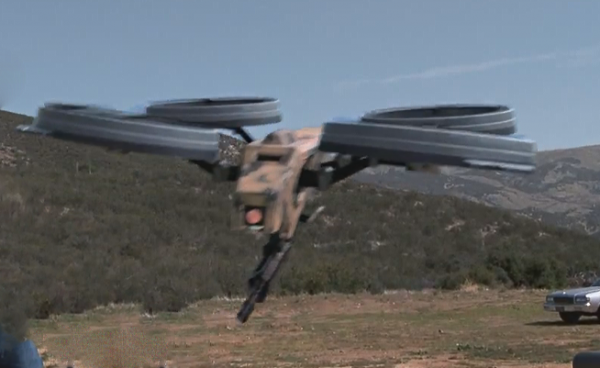
Looks like one of those propelled surveillance drones. Originally Posted by Deadstring67
-
09-25-2012, 01:22 AM #108 Re: Ancient, Medieval and Modern Weapon Guessing
Kani:

-
09-25-2012, 01:33 PM #109C.I.A.
- Join Date
- Jun 2006
- Posts
- 4,009
Re: Ancient, Medieval and Modern Weapon Guessing
Quadrotor Drone Equipped With a Machine Gun
Piloted by a tablet computer and capable of reaching heights of 1/4 mile and speeds of up to 30 mph. She's equipped with a submachine gun with a 100 round magazine and a small explosive charge to self-destruct should she be shot down or fall out of range.Her name is "Charlene". Still a prototype.
FPSRussia mentions that this technology may not be available for 10-15 years.
Last edited by Deadstring67; 09-25-2012 at 01:36 PM.
-
09-25-2012, 01:43 PM #110C.I.A.
- Join Date
- Jun 2006
- Posts
- 4,009
Re: Ancient, Medieval and Modern Weapon Guessing
Originally Posted by aljy
mura man og Ninja blade/sword whip ni ang isa.
existing ni nga weapon bro? karon pa man ko kita ani. ang isa sad naay ka pareha.

 Reply With Quote


Similar Threads |
|
 Posting Permissions


|