


The islands were claimed to have been marked on maps compiled during the time of Eastern Han Dynasty and Eastern Wu (one of the Three Kingdoms). Since the Yuan Dynasty in the 12th century, several islands that may be the Spratlys have been labeled as Chinese territory, followed by the Ming Dynasty and the Qing Dynasty from the 13th to 19th Century.I cited & highlighted those posts you got for Wikipedia. Thanks to it! But those proofs are somewhat "MAYBE" or walay klaro kay ila mga assumptions ug claim, nagbase ra sa mga maps entitled to their own perspective without consent on neighboring countries before. Second quote kay, ngano diay na sila nakuha nga chinese pottery. Di ba in the history, Chinese are great barter traders in the galleon, so basig dili sila descendant anang island or either camper lang for businesses only. In short, their valid claims are not justifiable gihapon. Ato nalang laktaron na naay dako kaayong makuha sa Spratlys mao aggressive sila which geographically they are not entitled. If way before those times, if they really camp out and owned that Island and build around it kay wala magtagad ang neighboring countries about the recent discoveries within that island, pretty valid na ila jud na,In 1755, archaeological surveys the remains of Chinese pottery and coins have been found in the islands and are cited as proof for the PRC claim.
View Poll Results: Is Scarborough Shoal worth fighting?
- Voters
- 119. You may not vote on this poll
-
YES
100 84.03% -
NO
19 15.97%
Results 841 to 850 of 4813
-
03-28-2012, 10:51 PM #841C.I.A.


- Join Date
- Oct 2009
- Posts
- 5,734
 Re: MERGED: Spratlys Issue
-
03-28-2012, 11:00 PM #842Senior Member

- Join Date
- Mar 2011
- Posts
- 525
Re: MERGED: Spratlys Issue
Sa dugay na panahon, ang mga Chinese maoy sige ug gamit sa Spratlys. Originally Posted by StingerRay

-
03-29-2012, 04:49 AM #843C.I.A.

- Join Date
- Jan 2011
- Posts
- 4,172
Re: MERGED: Spratlys Issue
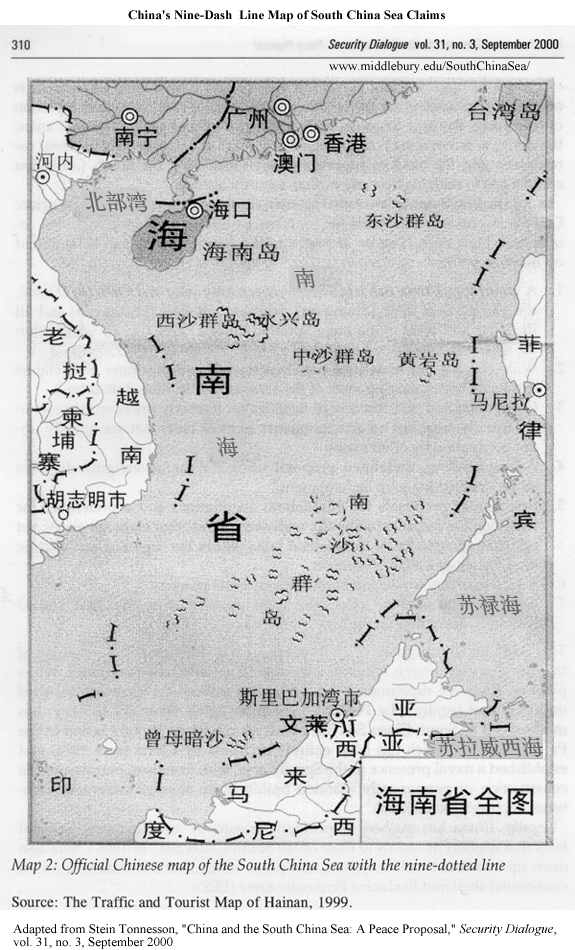
The 9-Dash line Map for me is more of a trade route rather than a territorial map... the dashes extends inland in Vietnam...
Last edited by balipseyev; 03-29-2012 at 05:03 AM.
-
03-29-2012, 04:50 AM #844C.I.A.
- Join Date
- Jan 2011
- Posts
- 4,172
Re: MERGED: Spratlys Issue
Philippines, Vietnam discuss joint exercises in West PH Sea
Philippines, Vietnam discuss joint exercises in West PH Sea - InterAksyon.comMANILA, Philippines - The Philippines and Vietnam discussed the possibility of conducting joint maritime exercises in the South China Sea, which Manila also calls the West Philippine Sea.
The prospect of having joint exercises came up during meetings between Philippine Navy chief Vice Admiral Alexander Pama with Vietnam People's Navy Admiral Nguyen Van Hien and General Do Ba Ty, chief the Vietnam People’s Army’s general staff.
Pama visited Vietnam and Thailand recently to enhance relationships and cooperation between the three countries’ navies.
The Philippine Navy chief and his Vietnamese counterpart discussed, among others, the forging of a memorandum of understanding on the "Enhancement of Mutual Cooperation and Information Sharing" and on standard operating procedures in the area of Southeast Cay and the Northeast Cay Islands in the disputed Spratlys.
-
03-29-2012, 05:01 AM #845C.I.A.
- Join Date
- Jan 2011
- Posts
- 4,172
Re: MERGED: Spratlys Issue
Kung in ani na argument, so pde diay i claim sa Mongolia ang CHINA... Originally Posted by Joseph20102011
-
03-29-2012, 09:30 AM #846C.I.A.

- Join Date
- Apr 2009
- Posts
- 6,075
Re: MERGED: Spratlys Issue
not until were united... china will just keep on bullying its ass at our doorsteps.
lets stop insulting each other, stop giving bad publicity.. let us all unite for one cause.
-
03-30-2012, 08:55 PM #847C.I.A.
- Join Date
- Jan 2011
- Posts
- 4,172
Re: MERGED: Spratlys Issue
Philippine, Chinese ships face off near Spratlys
NHK WORLD EnglishA senior Philippine military officer has revealed that Philippine and Chinese naval ships faced off near the disputed islands in the South China Sea in mid-March.
The military officer told NHK that a Chinese naval vessel approached a Philippine naval frigate on patrol in waters near the Spratly Islands.
The officer said tensions mounted between the 2 ships when they remained so close for some time as to be able to visually confirm each other's existence.
The officer said the face-off ended when the Chinese vessel left the scene.
The Philippines and China have territorial disputes over the Spratlys. The Philippines is conducting oil explorations in the waters called the Reed Bank near the islands. The country claims that the waters are within its exclusive economic zone. However, China strongly disputes this, arguing that the waters are within its EEZ.
-
03-30-2012, 09:20 PM #848C.I.A.

- Join Date
- Jan 2011
- Posts
- 8,151
Re: MERGED: Spratlys Issue
nabuhi na pd ni balik dah hehe
wa mn ni kahuman jud kay both EEZs intertwined...
-
03-30-2012, 09:32 PM #849Senior Member

- Join Date
- Jan 2012
- Posts
- 858
Re: MERGED: Spratlys Issue
kuyawa og naay mga trigger happy ato from both ships.
-
03-30-2012, 11:23 PM #850C.I.A.
- Join Date
- Jan 2011
- Posts
- 4,172
Re: MERGED: Spratlys Issue
EEZ is 200 Miles from shore... china is 500+ miles away, panu na intertwined... Originally Posted by brian joshua

 Reply With Quote
Similar Threads |
|
Tags for this Thread

 Posting Permissions


|