


St. Hippolytus
(Feast Day Aug 13 )
Hippolytus was a presbyter of the Church of Rome at the beginning of the third century. There is no difficulty in admitting that he could have been a disciple of St Irenaeus either in Rome or Lyons. It is equally possible that Origen heard a homily by Hippolytus when he went to Rome about the year 212. In the reigh of Pope Zephyrinus (198-217) he came into conflict with that pontiff and with the majority of the Church of Rome, primarily on account of the christological opinions which for some time had been causing controversies in Rome. Hippolytus had combated the heresy of Theodotion and the Alogi; in like fashion he opposed the false doctrines of Noetus, of Epigonus, of Cleomenes, and of Sabellius, who emphasized the unity of God too one-sidedly (Monarchians) and saw in the concepts of the Father and the Son merely manifestations (modi) of the Divine Nature (Modalism, Sabellianism). Hippolytus, on the contrary, stood uncompromisingly for a real difference between the Son (Logos) and the Father, but so as to represent the Former as a Divine Person almost completely separate from God (Ditheism) and at the same time altogether subordinate to the Father (Subordinationism). As the heresy in the doctrine of the Modalists was not at first clearly apparent, Pope Zephyrinus declined to give a decision. For this Hippolytus gravely censured him, representing him as an incompetent man, unworthy to rule the Church of Rome and as a tool in the hands of the ambitious and intriguing deacon Callistus, whose early life is maliciously depicted (Philosophumena, IX, xi-xii). Consequently when Callistus was elected pope (217-218 ) on the death of Zephyrinus, Hippolytus immediately left the communion of the Roman Church and had himself elected antipope by his small band of followers. These he calls the Catholic Church and himself successor to the Apostles, terming the great majority of Roman Christians the School of Callistus. He accuses Callistus of having fallen first into the heresy of Theodotus, then into that of Sabellius; also of having through avarice degraded ecclesiastical, and especially the penitential, discipline to a disgraceful laxity. These reproaches were altogether unjustified. Hippolytus himself advocated an excessive rigorism. He continued in opposition as antipope throughout the reigns of the two immediate successors of Callistus, Urban (222 or 223 to 230) and Pontius (230-35), and during this period, probably during the pontificate of Pontianus, he wrote the "Philosophumena". He was banished to the unhealthful island (insula nociva) of Sardinia at the same time as Pontianus; and shortly before this, or soon afterward, he became reconciled with the legitimate bishop and the Church of Rome. For, after both exiles had died on the island of Sardinia, their mortal remains were brought back to Rome on the same day, August 13 (either 236 or one of the following years), and solemnly interred, Pontianus in the papal vault in the catacomb of Callistus and Hippolytus in a spot on the Via Tiburtina. Both were equally revered as martyrs by the Roman Church: certain proof that Hippolytus had made his peace with that Church before his death. With his death the schism must have come to a speedy end, which accounts for its identification with the Novatian schism at the end of the fourth century, as we learn from the inscription by Damasus.
Results 341 to 350 of 701
Thread: We can learn from the Saints!
-
08-13-2011, 12:02 PM #341Senior Member


- Join Date
- Nov 2010
- Posts
- 562
 Re: We can learn from the Saints!
-
08-13-2011, 12:07 PM #342Senior Member
- Join Date
- Nov 2010
- Posts
- 562
Re: We can learn from the Saints!
 Originally Posted by petite fleur

Ahahahaa...your good mother is fighting a desperate battle ..."The Calling" against her earthly wisdom
 ...She loves you very much petite....you are really blessed
-
08-13-2011, 02:49 PM #343 Re: We can learn from the Saints!
@korz: murag ang no. eight ba kay mahimong smiley nga nag shades..sa story above ni St. Hippolytus
nindot ang stories ni St. Clare and St. Frances de Chantal....an inspiring reminder to get up each and everytime we fall.
-
08-13-2011, 03:22 PM #344 Re: We can learn from the Saints!
Originally Posted by koralstratz
I never thought I'd put cruel and funny in one sentence.... INdeed another perfect example of "Love endures all."...
"Dear Lord, help us to never lose sight of the things that give pleasure to You." for
"In You we live and move and have our being." (Acts 17:eighteen)Last edited by wenlove24; 08-13-2011 at 03:26 PM.
-
08-13-2011, 03:51 PM #345Elite Member

- Join Date
- Jul 2011
- Posts
- 1,344
Re: We can learn from the Saints!
Dah ambut niya. Haha. okay rana normal rana. tanan Mama mu agi man taleg ing-ana . Ge ingnan bitaw siya ako Auntie. "Nya imu diay e dili nga ganahan man" hehehe Originally Posted by koralstratz
Mag pinareha kong St. Clare ani nga mu-ikyas nya ma noktok sa purtahan? hahaha uso pa ba na ron? hehehe
-
08-13-2011, 03:54 PM #346Elite Member
- Join Date
- Jul 2011
- Posts
- 1,344
Re: We can learn from the Saints!
Ang Clarissian og ang Visitandine. Originally Posted by wenlove24
Anecdote~
Saint Jane Francis de Chantal was heading to the convent chapel one day to
pray. Encountering a young novice in the hallway, she said: why don't you
join me in the chapel for prayer? The young nun answered: Sister, I really
don't feel like praying right now. Whereupon Saint Jane retorted in her
no-nonsense way: Sister, I haven't felt like praying in years! Now, let's
go to the chapel and pray!"
Haha.
-
08-13-2011, 04:13 PM #347 Re: We can learn from the Saints!
He is the patron saint of those traveling by air, astronauts, and is the patron saint of pilots who fly for the NATO Alliance. He is the patron of paratroopers and those serving in the Air Force. He is also the patron of students taking exams. He is known as a patron saint of students, having struggled with being a poor student himself.
St. Joseph of Cupertino
Joseph was born Giuseppe Maria Desa in Cupertino, Apulia.
His father, Felice (Felix) Desa, was a carpenter in the fortified town of Cupertino, located in the heel of the boot of Italy, on the Apulian peninsula within the then Kingdom of Naples.Known locally as a charitable man, he often guaranteed the debts of his poorer neighbors, often driving himself into debt as a result. Felix died prior to Joseph's birth, leaving his wife Francesca Panara destitute and pregnant with the future saint.
As a child, Joseph was remarkably slow witted. He suffered from painful ulcers during his childhood, but after a hermit applied oil from the lamp burning before a picture of Our Lady of Grace, Joseph was completely cured of these. He was given the pejorative nickname "the Gaper," due to his habit of staring blankly into space. He was also said to have had a violent temper.
When he was 17, Joseph attempted to join the Friars Minor Conventuals, but his lack of education prevented him from gaining admittance. He was soon after admitted as a Capuchin, but removed from the order shortly thereafter when his constant fits of ecstasy proved him unsuitable. Eventually, in his early twenties, he was admitted into a Franciscan friary near Cupertino. He had a learning disability, and legend has it that he would study intently one small section of the material he was set to learn, because that was all he was able to do, and pray that the material he studied would be what he was tested on. One time when the friar administered a test, he happened to ask the one question Joseph had prepared for.
According to believers, Joseph could barely read or write, but continued to grow in holiness and wisdom, leading a life of poverty and prayer. He was unsuited for scholarship, but could answer intricate questions. He also performed menial tasks around the friary, such as gardening, looking after the animals, cleaning their stalls, and helping in the kitchen. Joseph was also often found wandering in a daze, winding up in different places in the friary unaware of how he got there.
When he was a candidate for deacon, the bishop at random asked Joseph to expound on the text "Blessed is the womb that bore thee." He did well. Thus he was ordained deacon. When it was a question of the priesthood, the first candidates did so well that the remainder of the candidates, Joseph among them, were passed without examination and Joseph was ordained a priest in 1628.
On October 4, 1630, the town of Cupertino held a procession on the feast day of Saint Francis of Assisi. Joseph was assisting in the procession when he suddenly soared into the sky, where he remained hovering over the crowd. When he descended and realized what had happened, he became so embarrassed that he fled to his mother's house and hid. This was the first of many flights, which soon earned him the nickname "The Flying Saint".
Joseph's life changed dramatically after this incident. His flights continued and came with increasing frequency. His superiors, alarmed at his lack of control, forbade him from community exercises, believing he would cause too great a distraction for the friary. For the fact was, Joseph could not contain himself. On hearing the names of Jesus or Mary, the singing of hymns during the feast of St. Francis, or while praying at Mass, he would go into a dazed state and soar into the air, remaining there until a superior commanded him under obedience to revive.
Joseph's most famous flight allegedly occurred during a papal audience before Pope Urban VIII. When he bent down to kiss the Pope's feet, he was suddenly filled with reverence for Christ's Vicar on earth, and was lifted up into the air. Only when the Minister General of the Order, who was part of the audience, ordered him down was Joseph able to return to the floor.
Among other paranormal events associated with Joseph, he is said to have possessed the gift of healing. Legend holds he once cured a girl who was suffering from a severe case of measles. Another story holds that an entire community suffering from a drought asked Joseph to pray for rain, which he did with success.
He also dedicated himself to improving the spiritual lives of his fellow friars.
Not all of the friars whom Joseph lived with were well disposed towards him. Some superiors would scold Joseph for not accepting money and gifts offered to him for curing people, especially when they were members of the nobility. He would also find himself in trouble for returning home with a torn habit as a result of the people seeking relics who regarded him as a prophet and a saint.
Perhaps the most difficult time came when Joseph was the subject of an investigation by the Inquisition at Naples. Msgr. Joseph Palamolla accused Joseph of attracting undue attention with his "flights", and claiming to perform miracles. On October 21, 1638, Joseph was summoned to appear before the Inquisition and, when he arrived, he was detained for several weeks. Joseph was eventually released when the judges found no fault with him.
After being cleared by the Inquisition, Joseph was sent to the Sacro Convento in Assisi. Though Joseph was happy to be close to the tomb of St Francis, he experienced a certain spiritual dryness. His flights came to a halt during this period.
Two years after his arrival at the Sacro Convento, Joseph was made an honorary citizen of Assisi and a full member of the Franciscan community. He lived in Assisi for another nine years. During this period Joseph was sought after by people (including ministers general, provincials, bishops, cardinals, knights and secular princes) who wanted to experience his divine consolation. He was happy to oblige, but the isolation of exile left him repressed. Believers were able to seek him out, but he was not allowed to preach or hear confessions, nor to join in the processions and festivities of feast days.
Over time, Joseph attracted a huge following. To stop this, Pope Innocent X decided to move Joseph from Assisi and place him in a secret location under the jurisdiction of the Capuchin friars in Pietrarubbia. Joseph was placed under strict orders to avoid writing letters, but he continued to attract throngs of people. This soon forced him to be moved to another location, this time to Fossombrone, which had little more success.
The ordeal finally ended when Pope Innocent X died, and the Conventual friars asked the newly elected Pope Alexander VIII to release Joseph from his exile and return him to Assisi. Alexander declined, and instead released Joseph to the friary in Osimo, where the Pope's nephew was the local bishop. There, Joseph was ordered to live in seclusion and not speak to anyone except the Bishop, the Vicar General of the Order, his fellow friars, and, in case of a health crisis, a doctor. Joseph endured his ordeal with great patience. Legend states he did not even complain when a brother-cook neglected to bring him any food to his room for two days.
On August 10, 1663, Joseph became ill with a fever, but the experience filled him with joy. When asked to pray for his own healing he said, "No, God forbid!" He experienced ecstasies and flights during his last mass which was on the Feast of the Assumption.In early September, Joseph could sense that the end was near, so he could be heard mumbling, "The jackass has now begun to climb the mountain!" The 'jackass' was his own body. After receiving the last sacraments, a papal blessing, and reciting the Litany of Our Lady, Joseph Desa of Cupertino died on the evening of September 18, 1663.
He was buried two days later in the chapel of the Immaculate Conception before great crowds of people.
Joseph was canonized on July 16, 1767, by Pope Clement XIII. In 1781, a large marble altar in the Church of St. Francis in Osimo was erected so that St. Joseph's body might be placed beneath it; it has remained there ever since.
-
08-13-2011, 04:34 PM #348 Re: We can learn from the Saints!
Like the many places he touched in Italy, his name has touched California through a town named after him: Cupertino, California, which is 50 miles south of San Francisco.
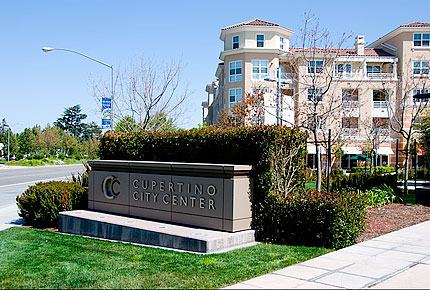
It was naturally fitting that in 1978, the Province of Conventual Franciscans in California adopted him as their patron. Ironically enough, Cupertino, California's public schools are among the highest ranked academically in the state of California.

One grammar school, Faria, is the very highest ranked in the state.
St. Joseph of Cupertino Church is the Catholic parish in Cupertino, California.

A life-sized bronze statue of St. Joseph in mid-flight was installed in the church prayer garden in 2008. The area where the city of Cupertino, California is today was first named in honor of St. Joseph of Cupertino on March 25, 1776, when Spanish explorers under Captain Juan Bautista de Anza camped in the area and named a small river for the Italian saint. The river is today known as Stevens Creek. (photo below)

-
08-13-2011, 06:47 PM #349C.I.A.
- Join Date
- Jul 2011
- Posts
- 1,921
Re: We can learn from the Saints!
this is amazing!
-
08-15-2011, 04:56 AM #350Senior Member
- Join Date
- Nov 2010
- Posts
- 562
Re: We can learn from the Saints!
Originally Posted by wenlove24
Hehe sorry sis,,gi-edit na nako....Mikalit ra man to..
Bitaw, inspiring kaayo tong spirituality ni St. Frances de Chantal..(NEVER give up )
)


 Reply With Quote

Similar Threads |
|
 Posting Permissions


|