


ok thx for d correction..
Results 61 to 70 of 85
Thread: Prehistoric world and Evolution
-
11-08-2009, 01:42 PM #61C.I.A.


- Join Date
- Jun 2009
- Gender

- Posts
- 2,887
-
11-08-2009, 02:31 PM #62Evolution Planet: But if humans evolved from apes, why are there still apes?
 Originally Posted by coolnezz

-RODION
-
11-08-2009, 04:54 PM #63C.I.A.

- Join Date
- Dec 2007
- Gender
- Posts
- 2,694
that guy didn't answer the question... he's blowing some hot air.
so if humans evolved to suit their environment blah blah blah... then how come humans in hot climates like africa, australia, etc, don't have big ears like the elephants to cool themselves down?
or humans from cold climates like siberia, alaska, etc, don't have thick furs, blubber, too warm themselves up so they don't freeze to death? they had millions of years to evolve and they can't even evolve to grow fur or whatever is necessary for them to survive without needing to kill another animal to get the fur? and why are humans able to communicate in complex languages? is that some kind of evolution? why are the millions of other animals aren't able to do that? why weren't the apes/monkeys/chimpanzees able to do that?
-
11-14-2009, 10:53 AM #64C.I.A.
- Join Date
- Jun 2009
- Gender
- Posts
- 2,887
lol
in proportion to their size , they dont need big ears to cool themselves. they were monkeys before in africa, they live in trees , however , they have to go to the ground , to move on to another tree. however on the ground there were lots of predators. so thats why they have to walk upright to have clearer sight if a predator is comming .how come humans in hot climates like africa, australia, etc, don't have big ears like the elephants to cool themselves down?
humans have furs , liek monkeys , however through time , they lost it since they are now walking upright , its suppose to cover them from harsh sun light , since theyre upright the fur left , is in the head which is the hair so as in pubic.or humans from cold climates like siberia, alaska, etc, don't have thick furs, blubber, too warm themselves up so they don't freeze to death?
now there were no monkeys in cold places before . however when they started to evolve to becom more intellgigent hunters , they learn to use sharp tools to hunt , from africa they traveled to europe where there is ice ,. at the same time there are also abundance of food , like bears that they cna hunt. so they settle on different places and live in caves.
they have furs as monkeys before , they evolve to have less . wats left is our hair .they had millions of years to evolve and they can't even evolve to grow fur or whatever is necessary for them to survive without needing to kill another animal to get the fur?
since lesser fur also helps to cool heir body dowmn.
different places , different languages , since this ealry humans traveled from africa to eaurope then to midle east then to russia , then to alaska where they were able to reach north america down to south america and bacame the aztecs/.and why are humans able to communicate in complex languages?
after this humans were evenly spread around the globe , diferen languages are spoken , . they have the intelligence , to communicate especially in hunting , until they found out that pronoucing words , makes everything easier .
if u born in the jungle like tarzan , u will only know murmuring .
most other animals comuncate too , bats echo , cats dogs , especially nonverbal like dancing.
why are the millions of other animals aren't able to do that? why weren't the apes/monkeys/chimpanzees able to do that?
-
11-14-2009, 11:06 AM #65C.I.A.
- Join Date
- Jun 2009
- Gender
- Posts
- 2,887
****************
Last edited by cromagnon; 11-14-2009 at 11:11 AM.
-
11-14-2009, 11:09 AM #66C.I.A.
- Join Date
- Jun 2009
- Gender
- Posts
- 2,887
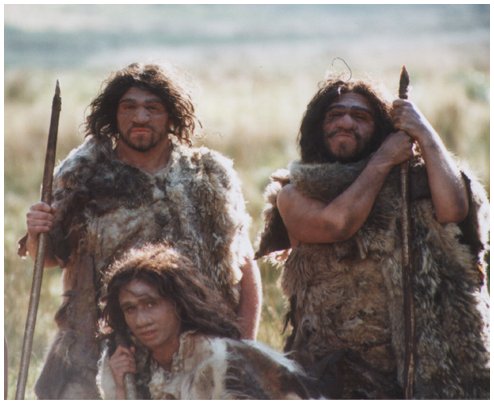
YouTube - Neanderthal - Episode 1 - Part 1 of 5
Neanderthal was the story of the rise and fall of one of the most successful human species that ever lived. A species that survived for over a quarter of a million years, living through and adaptin...
Neanderthal was the story of the rise and fall of one of the most successful human species that ever lived. A species that survived for over a quarter of a million years, living through and adapting to the most violent extremes of climate. A species that thrived - until modern man came along.
This revealing two-part drama documentary combined the latest scientific research with a stunning mixture of drama and cutting edge 3D animation to reconstruct the lives of these remarkable early humans. In the second part, the advanced Cro-Magnons arrive and a new Ice Age is dawning.
Neanderthal or Neandertal, is the common name given to any individual of the species Homo sapiens neanderthalensis (also known as Homo neanderthalensis), and to the entire species. Neanderthals have often been regarded as a subspecies of modern human beings (Homo sapiens sapiens or just Homo sapiens), but increasingly they are treated as a distinct species. Neanderthal remains span a timescale ranging from about 120,000 to 30,000 years ago and have been found in Middle Stone Age sites mainly in Europe and south-west Asia. The species is named after a site in the Neander River valley (German, tal, "valley") where the first skeletal remains to be recognized as belonging to this type were found.
Neanderthals had long, low, thick-boned skulls, with heavy brow ridges, in contrast to the high-domed, thin-walled skulls of modern human beings. The robust, heavily muscled frames of Neanderthals, with relatively long bodies and short legs, were well adapted to their hunter-gatherer lifestyle in the often extremely cold conditions leading up to the last Ice Age. Although males were more strongly built than females, both sexes were very muscular, even as children. Neanderthals had large heads with very large projecting noses and receding chins. On average their brains were as large or larger than the average modern human brain, which was probably related more to their large body size and heavy musculature, than heightened intelligence.
Although Neanderthal technology was fairly simple, there is evidence that they were capable hunters, and that they demonstrated a degree of compassion by caring for the infirm and the disabled, and by burying their dead. It has been suggested that Neanderthals practised cannibalism, but there is little substantial evidence in the archaeological record to support this theory. While some scientists believe that Neanderthals did not have the brain capacity to produce art, evidence to the contrary is slowly emerging. In 2003 a Neanderthal "mask"—a face carved from flint with bone for eyes—was found on the banks of the River Loire in France, indicating that Neanderthals may have been more sophisticated than previously thought.
Neanderthals disappeared from the archaeological record in Europe some 35,000 to 30,000 years ago, possibly as a result of the arrival of early modern people, who competed for the same resources[/quote]
-
11-26-2009, 12:32 AM #67C.I.A.
- Join Date
- Jun 2009
- Gender
- Posts
- 2,887
-
11-26-2009, 05:12 AM #68C.I.A.

- Join Date
- Jun 2009
- Gender
- Posts
- 3,548
Nice Nice Threads... ambit lang ko
Church and Science are already through with this. Many science theories and religious evidence shows.
And no one knows how old is the universe, it was just a theories that gave age to universe.
For me we don't really know or shall i say no one knows where we came from.
naay mangutana kinsa man ang gabuhat sa taw? some says God created us, on the other hands evolution takes place, then another question will be thrown who created those bacteria or those building blocks of life? their must a creator, then another question, who created that creator? hahahahays
mura ra kag nangutana unsay una itlog o manok
but i like this thread
-
11-27-2009, 03:59 AM #69C.I.A.
- Join Date
- Jun 2009
- Gender
- Posts
- 2,887
tnx , pero nature is already godlike , beautiful . but not superstion in irrational stories.
-
11-28-2009, 10:40 AM #70C.I.A.

- Join Date
- Jan 2009
- Gender
- Posts
- 2,477
you might want to read up on Henri Bergson.. He termed this the Elan Vital.. Originally Posted by cromagnon
and then there's Julian Huxley, who is by the way an evolutionary biologist.. who also has similar sentiments towards evolution.




Advertisement
Similar Threads |
|
 Posting Permissions


|